
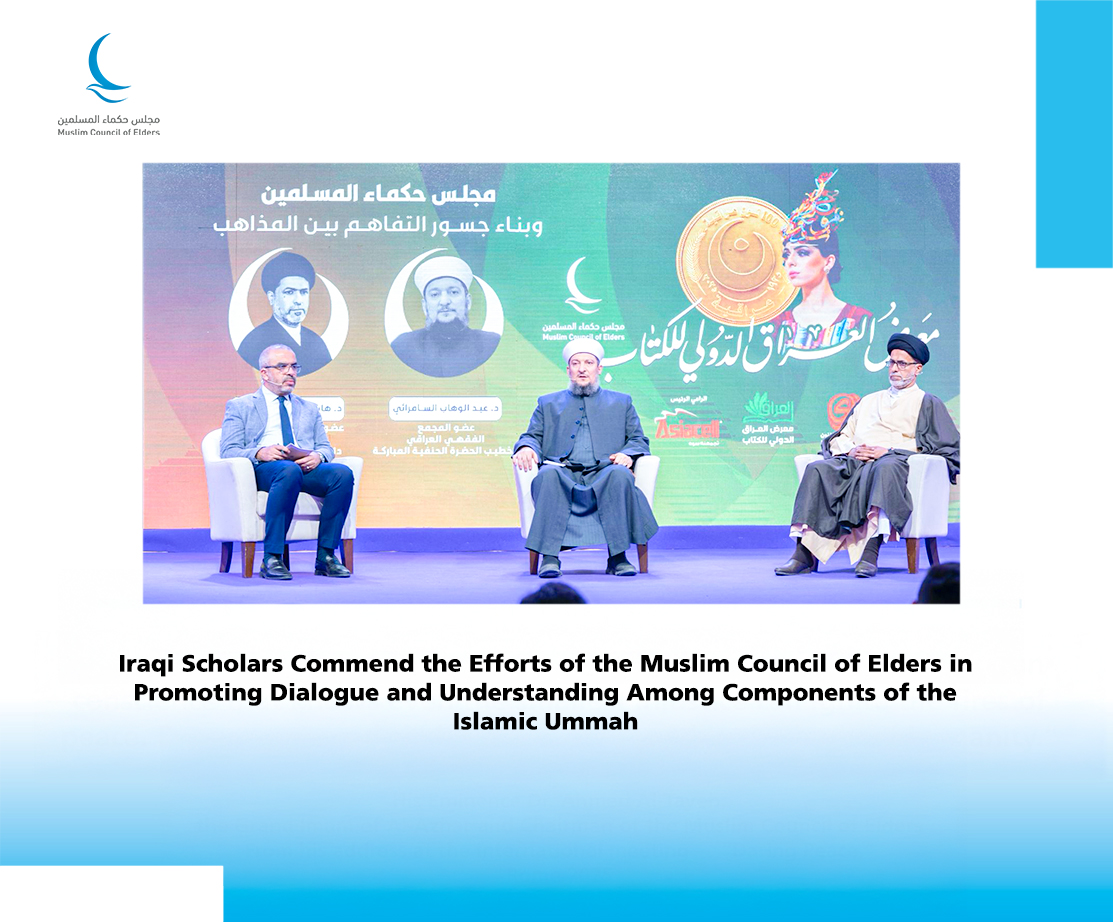
Iraqi Scholars Commend the Efforts of the Muslim Council of Elders in Promoting Dialogue and Understanding Among Components of the Islamic Ummah
The eighth day of the Iraq International Book Fair featured a symposium titled “The Muslim Council of Elders and Building Bridges of Understanding Among Muslims" on the fair’s main stage, attended by a group of scholars, thinkers, and those interested in religious and social affairs. The symposium included Sheikh Abdul Wahab Al-Samarrai, member of the Iraqi Jurisprudential Assembly and preacher at the blessed Hanafi shrine; Dr. Hashem Sarhan Al-Awadi, member of the advisory council of Al-Balaghi Center, Dar Al-Ilm for Imam Al-Khoei; and was moderated by Dr. Samir Boudinar, Director of the Al Hokama Center for Peace Research.
Dr. Boudinar opened the session by emphasizing the importance of dialogue and discussion in addressing issues within the Islamic community and promoting civil peace. He explained that today’s discussions focus on building bridges between schools of thought and authentic components, stressing that the Muslim Council of Elders plays a central role in fostering understanding among Muslims through its Intra–Islamic Dialogue initiative, which aims to strengthen communication between different schools and sects, alongside the Call of the People of the Qibla, which invites all Muslims to unity and cooperation in facing common challenges.
Dr. Abdul Wahab Al-Samarrai addressed the religious foundations of dialogue and Islamic unity, citing the Qur’anic verse: “Indeed this, your community, is one community, and I am your Lord, so worship Me.” He affirmed that unifying Islamic methodology does not mean erasing differences, but achieving balance between unity and sectarian identity. He stressed that internal Islamic dialogue is more urgent than ever, given the diversity of schools and intellectual traditions, and that dialogue should act as a healer seeking remedy, not as a wound-maker.
Al-Samarrai noted that the Call of the People of the Qibla represents a wise step toward strengthening unity without harming sectarian identities. He added that this call does not aim to dissolve sects or erase distinctiveness, but to agree on commonalities and reinforce them, affirming that difference is a sign of life and vitality in Islamic thought. He also highlighted the importance of removing sectarian and doctrinal disputes among Muslims, stating that unity must be built on mutual respect and understanding—not on forcing anyone to abandon their beliefs or orientations.
In his remarks, Dr. Hashem Sarhan Al-Awadi stressed the need to transform theoretical initiatives into practical frameworks within society, explaining that the participation of the Muslim Council of Elders in events such as the Iraq International Book Fair helps spread values of understanding and moderation across different segments of society.
He added that diversity and difference are natural parts of the Islamic community, citing the Qur’anic verse: “O mankind, indeed We have created you from male and female and made you peoples and tribes that you may know one another.” He affirmed that diversity is not a threat, but it is essential to have clear religious references to ensure accuracy and prevent misuse for personal agendas. He emphasized that community awareness and education represent the first line of defense against intellectual deviations, praising the initiatives led by the Muslim Council of Elders, which restore hope for unity and strengthen social cohesion.
This symposium comes as part of the Muslim Council of Elders’ ongoing efforts to promote civil and societal peace, and to spread values of dialogue and understanding among various Islamic components. It reflects Islam’s civilizational role in addressing divisions and conflicts and underscores the importance of intellectual and educational initiatives in building a cohesive and balanced society capable of confronting internal and external challenges alike.